
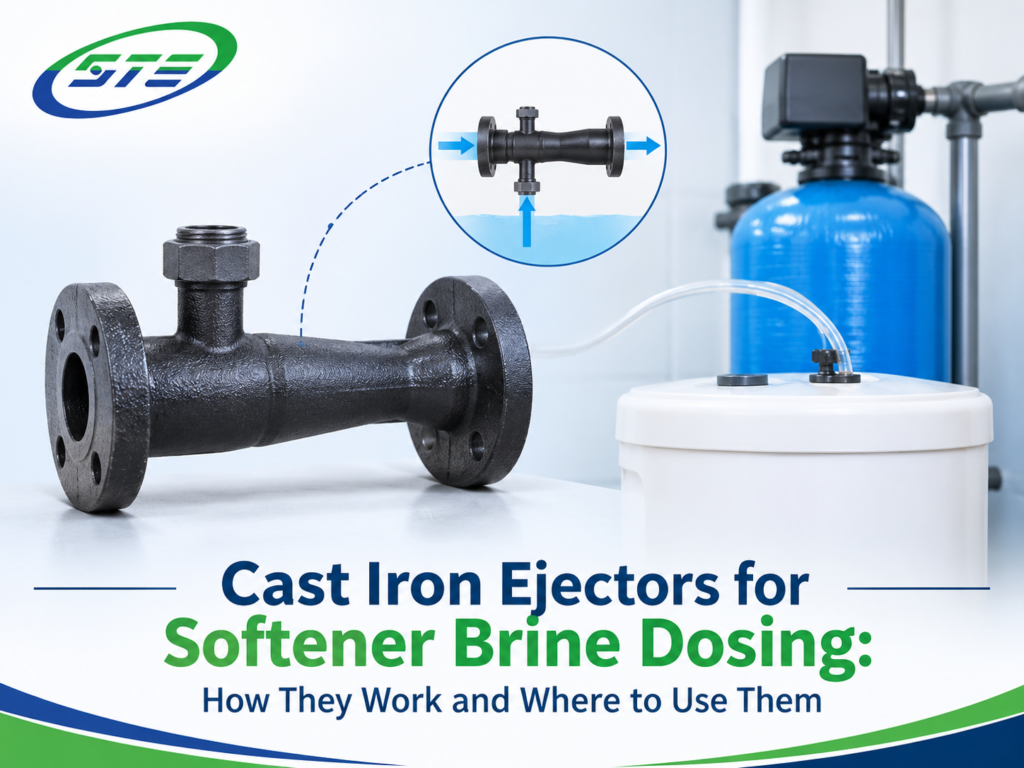
Ask a plant operator what fails first in a water softener, and the answer is rarely the resin. It is usually the small pump that draws brine during regeneration. A seal weeps, a motor trips, and a vessel is left half regenerated until the next morning, when the hardness test comes back wrong, and nobody is quite sure why.
That is one reason the cast iron ejector has stayed a fixture in softener plants for so long. It draws and dilutes brine using nothing but the pressure of the water already moving through your pipework. No motor, no seal, no power supply to trip. For anyone responsible for steady soft water, that is a very short list of things that can go wrong. Here is how it works, why the material matters, and where it fits.
What a Brine Ejector Does During Regeneration
A softener swaps calcium and magnesium for sodium until the resin runs out of exchange capacity. Regeneration restores that capacity by passing a salt solution through the bed. The strong brine in your tank must reach the vessel at the right dilution, rate, and duration. That job belongs to the brine ejector.
In a typical cycle, backwash loosens and cleans the bed. Then the brine draw and slow rinse move diluted brine down through the resin. A fast rinse finishes the job by flushing out leftover salt. The ejector works in the middle stage; it pulls brine out of the tank and blends it into the water heading for the vessel.
Get that stage wrong, and the cost shows up quickly: too little brine and hardness breaks through early, too much and you burn salt and rinse water.
How a Cast Iron Ejector Works
The principle is the venturi effect, and it is simpler than it sounds.
Three things happen in a few centimetres.s
Pressurised water enters the ejector and is forced through a narrow nozzle. As it squeezes through that opening, the water speeds up sharply, and its pressure falls. Right at the nozzle exit, the pressure drops low enough to create suction.
That suction point is connected to the brine line. The mixing section draws brine from the tank and meets the fast water jet. The two streams combine and pass through a diffuser, where the speed drops and pressure recovers. The ejector discharges diluted brine with enough pressure to travel into the softener vessel and down through the resin bed.
Why the ratio stays steady
Because the geometry is fixed- the nozzle size, throat, and diffuser- the proportion of motive water to brine is set by design rather than by an operator or a controller. Sai-Tech builds ejectors in different ratios, from 1:1 unibody designs to 1:5 two-part constructions, so dilution can match how a plant runs its regeneration. Nothing rotates, nothing is adjusted mid-cycle, and nothing depends on electricity.
Why Cast Iron for Brine Duty
Brine is not gentle. Salt solutions are corrosive, and a water softener brine ejector sees them every time the plant regenerates. Material choice decides how long the unit lasts, and it is the question we get asked most often.
Our cast iron ejector is an unlined design, cast in local forges using our own proprietary die units. The body is built to withstand the pressure and knocks of an industrial plant, and we finish it with a colour coating or to the client’s own QAP. The nozzle sees the harshest conditions, and we use brass or gunmetal, held to the same quality standard as the body.
In our experience, that pairing is what keeps performance consistent. Most people don’t realise that a worn nozzle quietly changes suction. A changed suction means a changed brine draw, and that shows up in your water quality long before anyone thinks to inspect the ejector.
Customers have run these units for years without complaints, and we are happy to let that record speak for itself.
Where a Cast Iron Ejector Makes Sense
Softener and caustic duty
The natural home is the softener plant. Brine dosing for resin regeneration is the core use, and the same design handles caustic in softener units, which is what it was built for. The range scales too, with flow rates of up to 200 m3/hr, so it suits a compact skid just as well as a large industrial installation.
Sugar factories, fertiliser plants, steel units and boiler feed pretreatment are all familiar territory for us, and they share one priority: dosing that works every cycle without a maintenance routine attached.
Where it is not the right choice
Here’s where we would rather be straight with you. A cast iron ejector isn’t the answer for every dosing job. If your plant is a DM plant dosing hydrochloric or sulphuric acid, an unlined cast body is the wrong tool. That duty calls for an ebonite-lined MSEL or CSEL ejector, or PP, SS, or Teflon constructions for more aggressive chemicals.
Match the material to the chemical, not the other way round. Brine and caustic in a softener unit sit comfortably with cast iron and a brass or gunmetal nozzle. Acid does not.
Choosing a Water Softener Brine Ejector
Once you know cast iron suits the duty, a few practical points decide whether the ejector performs on site.
Motor water pressure and flow. An ejector draws as well as the water feeding it. If the inlet pressure is below the design point, suction suffers, and no amount of downstream adjustment will fix it. Know your pressure at the ejector inlet during regeneration, not just at the plant header.
Back pressure from the vessel. The ejector has to push diluted brine through the distributor and resin bed. If back pressure is higher than expected, the draw slows. This is the most common reason a correctly sized ejector looks underpowered.
Dilution ratio. Decide the brine strength you want at the resin, then choose the ratio to match. Changing it later usually means changing the ejector.
Nozzle condition and spares. Since the nozzle controls everything, it is worth knowing you can replace it on its own. Ejector nozzles are part of our range, so a worn one does not mean replacing the whole unit.
Small Habits That Extend Ejector Life
- Keep solids out of the nozzle. Commercial salt carries insoluble matter that can settle in the brine tank. A strainer or filter on the brine suction line stops that grit from lodging in the nozzle.
- Watch the brine tank level. If the time taken to draw a normal quantity of brine starts creeping up, treat it as an early signal. Check the nozzle and the suction line before the resin pays for it.
Pump-Free Dosing That Keeps Doing Its Job
Every softener cycle depends on an accurate, repeatable brine draw that’s free of fuss. A cast iron ejector delivers that with flowing water and well-made metal, and a good brine ejector should be the least interesting part of your plant.
If you are specifying one for a new softener unit, replacing a pump you are tired of repairing, or simply checking whether your current setup is right for your duty, the team at Sai-Tech Engineers is happy to talk it through. Tell us your motive pressure, flow, and ratio, and we can help you choose the right ejector for the job. Explore the full range at MSEL Ejectors.