SEO

common ejector problems

Common Ejector Problems and How to Troubleshoot Them

A plant engineer called us last monsoon with a familiar complaint: “The ejector was working fine for months, and now it’s barely pulling suction.” Nothing had changed on paper: same motive pressure, same fluid, same setup. But something had shifted, and figuring out what usually comes down to a short list of usual suspects. If you run process equipment long enough, you learn that ejector troubleshooting is less about mystery and more about method. Ejectors have no moving parts, which is exactly why they’re trusted across water treatment, chemical dosing, and sugar processing plants. But “no moving parts” doesn’t mean “nothing can go wrong.” It just means the problems, when they show up, tend to come from a narrower set of causes than you’d get with a mechanical pump. Why Ejectors Fail Less Often, But Still Fail Here’s where things get interesting. Because an ejector relies purely on the Venturi principle, converting motive fluid pressure into velocity, then back into pressure, most of its problems trace back to something disrupting that pressure-velocity relationship rather than a component wearing out. In our experience manufacturing and troubleshooting ejectors for DM plants, softener systems, and fertiliser facilities, the same handful of issues show up again and again across industries. Common Ejector Problems #1: Loss of Suction or Weak Vacuum This is the complaint we hear most often, and it’s usually one of these: Insufficient motive pressure – If the pressure feeding the nozzle drops below the ejector’s designed operating range, the velocity through the throat won’t be high enough to create adequate suction. Check upstream pressure first; it’s the simplest thing to rule out and the most commonly overlooked. Nozzle wear or partial blockage – Even a slight buildup of scale or debris at the nozzle changes the flow geometry enough to weaken suction. Since MSEL and similar ejectors are engineered around precise nozzle dimensions, even minor obstruction has an outsized effect. Worn or damaged internals – In ejectors handling abrasive or highly corrosive fluids, internal surfaces can erode over time depending on the material of construction. This is one of the reasons matching MOC (MS Ebonite Lined, SS, PP, or Teflon) to the actual chemical environment matters so much upfront. Common Ejector Problems #2: Inconsistent Mixing Ratio What most people don’t realise is that a fixed mixing ratio depends on stable inlet conditions on both the motive and suction sides. If the secondary fluid’s viscosity, temperature, or supply level fluctuates, the ratio drifts even though the ejector itself hasn’t changed. Ejector troubleshooting here usually means checking the suction-side conditions before assuming the unit is at fault. Common Ejector Problems #3: Leakage at Joints or Fittings This sounds mechanical, but it’s rarely about the ejector body itself. In our experience, leakage traces back to gasket degradation, thread wear, or incorrect torque during installation, particularly in ejectors handling acid or caustic dosing, where even minor seepage is a safety concern. Regular visual inspection at connection points catches this early, well before it becomes a larger issue. Common Ejector Problems #4: Reduced Discharge Pressure If the ejector is entraining fluid but the discharge pressure downstream is lower than expected, the diffuser section is often where the issue lies. A partially obstructed or eroded diffuser prevents the velocity-to-pressure conversion from completing properly, so suction might look fine while discharge performance suffers. This is a subtler failure mode, and it’s one where a straightforward visual check doesn’t always reveal the cause. Ejector Problems and Solutions: A Practical Troubleshooting Sequence Here’s the sequence we walk plant teams through when something feels off: Verify motive fluid pressure at the ejector inlet against the original design specification. Inspect the nozzle for scale, debris, or wear, since this is the single most common root cause of weakened suction. Check suction-side conditions, fluid level, viscosity, and temperature, if the mixing ratio has drifted rather than suction failing outright. Examine joints and fittings for leakage, especially after any recent maintenance or reinstallation work. Assess the diffuser section if discharge pressure has dropped but suction still seems adequate. Confirm material compatibility hasn’t been compromised by a process change, since switching to a more aggressive chemical without reassessing MOC is a frequent, avoidable cause of premature wear. Most ejector problems and solutions map onto this same logic: isolate whether the issue is on the motive side, the suction side, or the discharge side, and the root cause narrows quickly. When Troubleshooting Points to a Design Mismatch Here’s the part that’s easy to overlook: sometimes what looks like a maintenance issue is actually a sign that the original ejector wasn’t matched precisely enough to the process conditions in the first place. A generic ejector working at the edge of its capacity will show recurring problems that no amount of cleaning or part replacement fully resolves. If troubleshooting keeps circling back to the same symptom, it’s usually worth asking whether the nozzle geometry, throat diameter, or material of construction was ever validated against your actual operating parameters. Getting Ahead of the Problem The plants that deal with ejector issues least often aren’t the ones with the newest units. They’re the ones that built a simple inspection routine into their maintenance calendar, checking motive pressure, inspecting the nozzle, and reviewing fluid conditions periodically rather than waiting for performance to visibly drop. Given how few components an ejector actually has, this kind of preventive check takes far less effort than troubleshooting a mechanical pump ever would. At Sai-Tech, we’ve spent over two decades manufacturing ejectors and working directly with plant teams when something isn’t performing as expected. If your ejector is showing any of the patterns above and a quick check hasn’t resolved it, it’s worth walking through your specific setup with someone who can look at the nozzle design, MOC, and operating conditions together, rather than troubleshooting each in isolation.  

Common Ejector Problems and How to Troubleshoot Them Read More »
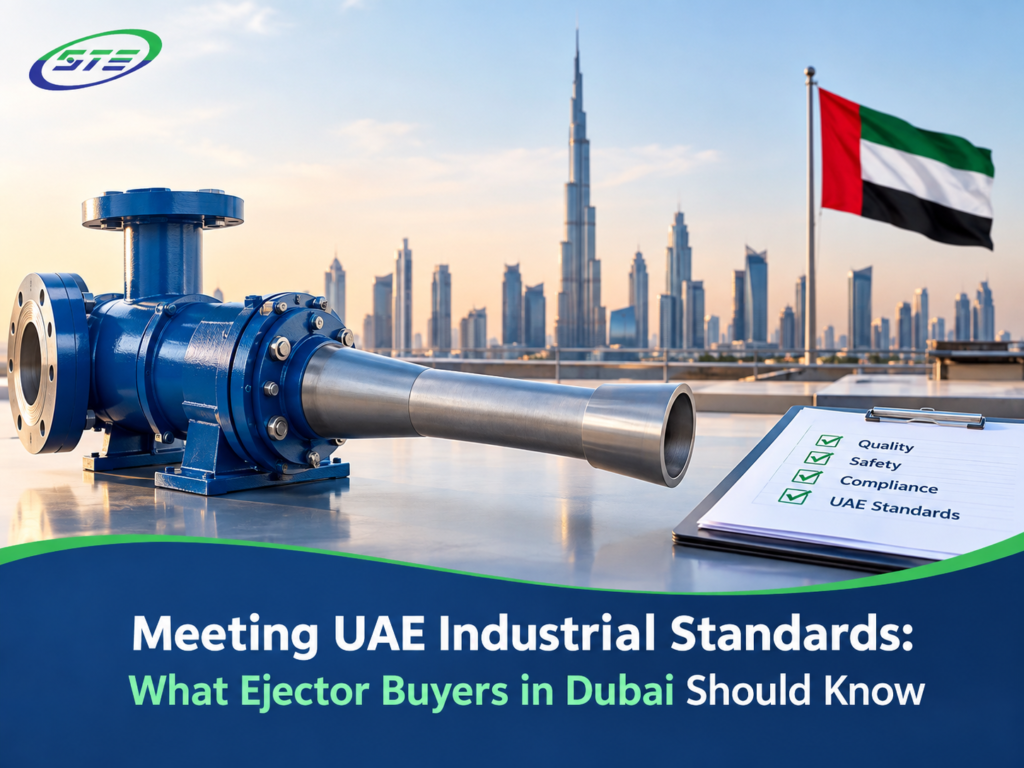
UAE industrial equipment standards

Meeting UAE Industrial Standards: What Ejector Buyers in Dubai Should Know

A procurement engineer in Jebel Ali once put it plainly: “The ejector itself was never the problem. Clearing customs with it was.” That single line captures what many buyers discover only after their shipment gets held up: sourcing the right equipment and meeting the UAE’s compliance expectations are two different challenges, and getting one right doesn’t guarantee the other. If you’re specifying an ejector for a water treatment plant, a chemical processing unit, or a desalination facility in the UAE, understanding UAE industrial equipment standards isn’t a bureaucratic afterthought. It’s part of the engineering decision itself, right alongside material selection and mixing ratio. Why UAE Industrial Equipment Standards Matter More Than Buyers Expect Here’s where things get interesting. Most industrial buyers assume that if a piece of equipment performs well and comes from a reputable manufacturer, it will clear import without friction. In practice, the UAE’s regulatory environment, shaped by ESMA (Emirates Authority for Standardisation and Metrology) and Dubai Municipality requirements, layers additional scrutiny on top of pure performance criteria. What most people don’t realise is that UAE industrial equipment standards aren’t just about the equipment functioning correctly under operating conditions. They also govern documentation, material traceability, conformity marking, and in some cases, third-party testing certificates that need to accompany the shipment before it ever reaches the plant floor. An ejector that performs flawlessly on paper can still sit in a bonded warehouse if the compliance trail behind it is incomplete. Dubai Import Compliance for Ejectors: What Actually Gets Checked In our experience working with buyers across the Gulf, Dubai import compliance for ejector equipment tends to focus on a few recurring areas: Material of Construction (MOC) Documentation Whether you’re importing an MS Ebonite-lined ejector, an SS316 unit, or a Teflon-lined design for highly corrosive dosing, customs and regulatory bodies increasingly expect clear material certification. This isn’t unique to ejectors, but it catches buyers off guard because domestic suppliers rarely ask for this level of paperwork upfront. Pressure and Process Rating Declarations Since an ejector operates on the Venturi principle, using motive fluid pressure to entrain and mix a secondary liquid, the equipment’s rated operating pressure needs to be documented clearly. Dubai import compliance checks often verify that declared specifications match what’s stamped or labelled on the unit itself. Conformity Marking and Origin Documentation Depending on the application, whether it is a DM plant, a fertiliser facility, or a sugar processing unit, buyers may need country-of-origin certificates and conformity declarations that align with ESMA’s framework. Skipping this step is one of the most common reasons shipments get delayed at the port rather than at the factory. Ejector Certification UAE: Separating What’s Optional From What’s Not This is the part that’s easy to overlook. Not every ejector requires the same level of certification, and treating every import as if it needs the maximum paperwork wastes time, while under-documenting a critical process application creates real risk. Ejector certification UAE requirements generally scale with the criticality of the application. A softener ejector dosing brine in a low-hazard setting typically faces lighter scrutiny than an ejector used for acid or caustic dosing in resin regeneration, where the consequences of equipment failure are far more serious. If your project falls into a regulated sector, such as water treatment infrastructure tied to a municipal or semi-government contract, expect the certification bar to sit considerably higher. The practical takeaway: talk to your supplier about certification requirements before the design is finalised, not after the purchase order is signed. A manufacturer with export experience into the UAE will already know which test certificates, material traceability documents, and conformity declarations typically accompany a shipment for your specific application. Why Manufacturing Origin Affects Compliance Outcomes At Sai-Tech, having shipped ejectors into the UAE, Saudi Arabia, and across the wider Gulf region for years, we’ve seen how manufacturing discipline upstream directly shapes how smoothly equipment clears compliance downstream. An ejector built with rigorous in-house testing and proper raw material vetting doesn’t just perform better in the field; it also comes with a documentation trail that satisfies UAE industrial equipment standards without last-minute scrambling. This matters because ejectors, unlike pumps, have no moving parts to fail mechanically, which is precisely why plants across water treatment, fertiliser production, and chemical processing prefer them. But that reliability advantage only translates into a smooth import experience when the manufacturer treats certification and traceability as seriously as they treat nozzle geometry and diffuser design. Getting Dubai Import Compliance Right From the Start A few practical habits make a real difference for buyers navigating this process: Ask your supplier directly which certificates accompany the shipment, rather than assuming standard documentation covers UAE-specific requirements. Confirm material and pressure ratings are documented in a format that aligns with ESMA expectations, not just generic technical datasheets. Clarify early whether your specific application (municipal water treatment, for instance) triggers a higher compliance tier than a standard industrial process. Build in lead time for documentation review, since compliance delays at the port are often more time-consuming to resolve than manufacturing lead times themselves. Where This Leaves UAE Buyers Meeting UAE industrial equipment standards isn’t about adding red tape to an already technical purchasing decision. It’s about recognising that in a market like Dubai, equipment quality and equipment compliance move together, and treating them as separate conversations is usually what causes the delays buyers are trying to avoid. If you’re evaluating an ejector for a project in the UAE and want to understand what certification and documentation your specific application will require, it’s worth having that conversation with your manufacturer before finalising specifications. At Sai-Tech, we work directly with buyers across the Gulf to make sure the ejector that leaves our facility clears compliance as smoothly as it performs on the plant floor.  

Meeting UAE Industrial Standards: What Ejector Buyers in Dubai Should Know Read More »

Industrial Ejector Buying Guide

A Buyer’s Checklist Before Ordering an Industrial Ejector

Somewhere in India right now, a procurement manager is staring at three ejector quotes that all look roughly the same on paper, and has no real way to tell which one will actually hold up in their plant. The prices are close. The datasheets use similar language. And the decision, more often than not, comes down to whichever supplier answered the phone first. That is not how you should be buying industrial ejectors. An ejector might look like a simple piece of pipe fitting from the outside, but the wrong specification can mean chemical leakage, premature corrosion, or a dosing ratio that never quite matches what your process needs. This industrial ejector buying guide walks through exactly what to check before you place an order, so you are choosing based on specification, not guesswork. Start With the Chemical, Not the Ejector Here’s where things get interesting: most buyers start by asking what ejector sizes or models are available, when the first question should really be about the chemical itself. What are you dosing, at what concentration, and at what temperature? An ejector that performs perfectly with caustic at ambient temperature may not be suitable for the same caustic solution running at 70 degrees Celsius. Get this wrong at the start and every other decision downstream- material of construction, lining, ratio- gets built on a shaky foundation. Write down the chemical, the concentration range, and the operating temperature before you request a single quote. Material of Construction: The Decision That Matters Most This is the single biggest factor in how long your ejector lasts. In our experience at Sai-Tech, this is also the step buyers rush through the fastest, usually because the options can feel interchangeable from a distance. They are not. Mild Steel Ebonite Lined (MSEL) The standard, cost-effective choice for hydrochloric acid and caustic dosing in controlled conditions, typically up to around 55 degrees Celsius. This covers a large share of standard water treatment and DM plant applications. Carbon Steel Ebonite Lined (CSEL) Built for the same chemical range as MSEL but with a carbon steel outer body instead of mild steel, often selected to match an existing plant standard or specific engineering preference. PP, SS, and Teflon-Lined Options For more aggressive chemicals, higher purity requirements, or higher operating temperatures, such as sulphuric acid applications, these materials offer greater chemical resistance where MSEL or CSEL would not be appropriate. Whichever material you land on, the lining is doing the real work against the chemical. Never accept a quote that does not clearly state what the lining and outer body materials are. Build an Ejector Specifications Checklist Before You Ask for a Quote What most people don’t realise is that a vague enquiry gets a vague quote back. If you send a supplier your requirements clearly, you get a specification that actually matches your process. Before reaching out to any industrial ejector supplier, have these details ready: Motive fluid and secondary fluid: what is driving the ejector, and what is being drawn in Dosing ratio required: commonly 1:1 or 1:5, though custom ratios are available for specific applications Operating pressure and flow rate: the ejector needs to be sized correctly against your available line pressure Temperature range: both normal operating and any occasional peak conditions End connections: flanged or threaded, and to what standard your existing piping uses Construction type: unibody (typically 1:1 ratio) or two-part construction (typically 1:5 ratio) Installation environment: indoor, outdoor, or any specific space constraints at the point of installation Handing this over upfront saves several rounds of back-and-forth and gets you a far more accurate quote the first time. Questions to Ask Any Industrial Ejector Supplier Not every supplier manufacturing ejectors is built the same way, and the questions below tend to separate the ones worth ordering from over time from the ones you should be cautious about. How long have you been manufacturing ejectors, and what industries do you serve? Experience across sectors like water treatment, fertilisers, and steel production tends to mean a supplier has already encountered edge cases similar to yours. What quality testing happens before dispatch? Ask specifically whether raw materials are vetted and whether finished units are tested in-house before they ship. This is where a lot of variation between suppliers actually shows up. Is there a warranty against manufacturing defects? A supplier confident in its manufacturing process will typically stand behind the product with a defect warranty. If that is missing or vague, treat it as a signal. Can you supply across multiple materials of construction? A supplier that only offers one material option cannot always tell you honestly when a different one would suit your application better. What is your capability for custom ratios or connection types? Standard specifications work for most applications, but plants with non-standard piping or unusual dosing ratios need a supplier who can actually accommodate that, not just say yes and figure it out later. Don’t Skip the Application Match An ejector correctly built for DM plant regeneration dosing is not automatically right for softener brine dosing, even though both fall under water treatment. Confirm that the specific application you are solving for, whether it is acid and caustic dosing in a DM plant, brine dosing in a softener, or a dosing requirement in steel or fertiliser processing, is one the supplier has actual experience with, rather than a generic catalogue match. Bringing It All Together Buying an industrial ejector does not need to be complicated, but it does reward preparation. Know your chemical and its operating conditions. Get the material of construction right before anything else. Walk into the conversation with your specifications checklist already filled out. And choose a supplier who can answer the harder questions about testing, warranty, and application experience without hesitating. At Sai-Tech Engineers, we have spent close to three decades helping plants across India and overseas get this decision right the first time, across MSEL, CSEL, PP, SS, and Teflon ejector ranges. If you have a dosing

A Buyer’s Checklist Before Ordering an Industrial Ejector Read More »

MSEL vs CSEL ejector

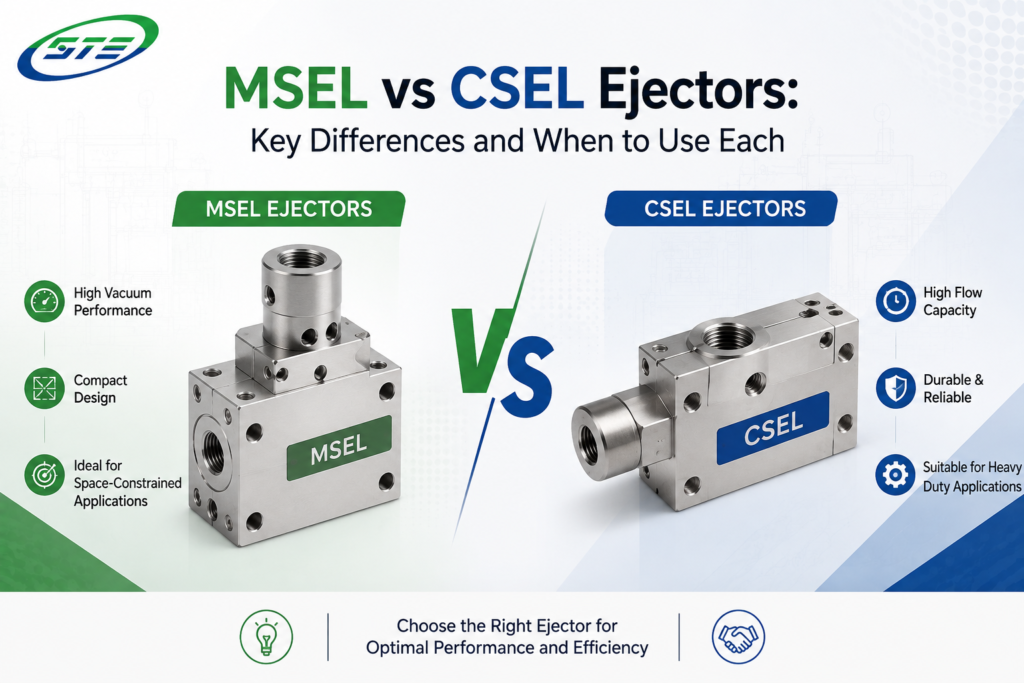
MSEL vs CSEL Ejectors: Key Differences and When to Use Each

A plant engineer once told us he had spent three days chasing a dosing pump fault before someone suggested he simply switch to an ejector. No motor, no seals, no moving parts to wear out. That conversation is where most people’s ejector journey starts.  But once they are sold on the idea of a venturi-based ejector, a second question follows almost immediately: MSEL or CSEL, which one actually fits my plant? It sounds like a small detail. It isn’t. Get the body material wrong on a chemical dosing ejector, and you are looking at premature corrosion, unplanned shutdowns, and a replacement order sooner than you budgeted for. At Sai-Tech Engineers, we get asked about MSEL vs CSEL ejector selection almost every week, usually from someone comparing quotes or specs and unsure which one their process actually needs. This piece walks through what separates the two, so you are not guessing. What Makes an Ejector “MSEL” or “CSEL” in the First Place Before comparing the two, it helps to understand what the letters stand for. MSEL is short for Mild Steel Ebonite Lined. CSEL stands for Carbon Steel Ebonite Lined. Both are among the standard types of ejectors that Sai-Tech manufactures for chemical dosing applications, and both work on the same operating principle: a high-pressure motive liquid passes through a nozzle, creates a vacuum, and draws in a secondary liquid at a fixed ratio. No pump, no power supply, no moving internals to maintain. Where they differ is in the outer body construction. The MSEL Ejector uses a mild steel outer body with plate-type flanged end connections, and threaded connections can be made on request for specific installations. The CSEL Ejector uses a carbon steel outer body, also with plate-type flanges as standard, with threaded options available for custom requirements. Both are internally lined with ebonite, which is the layer actually doing the work of resisting the chemical being dosed. MSEL Ejectors: Where They Fit Best The MSEL Ejector is Sai-Tech’s standard product for what we would call typical service conditions. It is built for hydrochloric acid and caustic dosing applications where the corrosion factor is manageable, and the operating temperature stays within 55 degrees Celsius. In our experience, this is the ejector that most water treatment plants, DM plants, and softener systems reach for first, because it covers the majority of standard chemical dosing needs without over-specifying the equipment. If your process runs HCl or caustic at controlled, moderate temperatures, MSEL is usually the practical, cost-effective starting point. Every MSEL Ejector from Sai-Tech comes with a warranty against manufacturing defects, and each unit goes through multiple in-house quality tests before it leaves the factory. That is not a marketing line. It reflects how we have approached manufacturing since 1996, and it is part of why plants across India and overseas keep coming back to us as their ejector manufacturer of choice. CSEL Ejectors: Where They Come In The CSEL Ejector serves the same core purpose, dosing HCl and caustic, but with a carbon steel outer body instead of mild steel. What most people don’t realise is that this is not a case of one material being universally “stronger” than the other. Carbon steel and mild steel behave differently in terms of durability, machinability, and how they hold up under specific plant conditions, which is why Sai-Tech offers CSEL as a distinct option rather than a simple upgrade tier. Like the MSEL, the CSEL Ejector is rated for hydrochloric acid and caustic applications up to 55 degrees Celsius, and it carries the same warranty and quality-testing standards. The decision between the two usually comes down to what your plant’s engineering team specifies for the outer body, based on the installation environment, existing piping standards, or a preference already established at the facility. MSEL or CSEL: Which Is Better for Your Application? Here’s where things get interesting. There is no single answer to which one is objectively better, because the honest answer depends on what your process actually needs. A few questions worth considering before you decide: What chemical are you dosing, and at what temperature? If you are working with HCl or caustic within the 55-degree Celsius range, both MSEL and CSEL are viable. If your process runs hotter or involves something more aggressive like sulphuric acid, that shifts the conversation toward a different material altogether, such as PTFE or Teflon-lined ejectors, which Sai-Tech also manufactures for higher temperature and higher corrosion service. Do you already have a body material standard at your plant? Many facilities standardise on either mild steel or carbon steel across their piping and fittings for procurement and maintenance consistency. If that is the case, matching your ejector to the existing standard usually makes the most operational sense. What does your budget and delivery timeline look like? MSEL is Sai-Tech’s most widely stocked standard configuration, which often makes it the faster and more economical route for straightforward dosing needs. CSEL is equally reliable but may be worth confirming lead times on if your project has a tight schedule. Are you working within a 1:1 or 1:5 ratio setup? Sai-Tech manufactures both MSEL and CSEL Ejectors across 1:1 ratio unibody construction and 1:5 ratio two-part construction, so ratio requirements do not restrict your material choice. This is worth flagging to whoever is finalising your ejector spec. Why the Material Choice Deserves More Attention Than It Gets It is tempting to treat the outer body material as a minor line item on a purchase order. We would push back on that. An ejector’s outer body is what stands between your process fluid and the surrounding plant environment for years of continuous or intermittent service. Getting it wrong does not usually cause an immediate failure. It shows up eighteen months later as unexplained leakage, a support engineer on site, and a production line waiting on a replacement part that should have been correctly specified the first time. This is also why Sai-Tech has stayed focused on rigorous raw material

MSEL vs CSEL Ejectors: Key Differences and When to Use Each Read More »

sustainable fluid handling

Why Ejectors Are the Sustainable Alternative to Traditional Pumps

Industrial operations are under increasing pressure to do more with less. Reducing energy consumption, lowering maintenance costs, and meeting sustainability goals have become just as important as maintaining production efficiency. While pumps have long been the standard choice for fluid transfer and vacuum generation, many industries are now exploring alternatives that deliver the same performance with a smaller environmental footprint. This is where sustainable fluid handling solutions like ejectors stand out. Unlike conventional pumps that rely on moving mechanical components, ejectors operate using the principle of fluid dynamics. Their simple yet effective design makes them highly reliable, energy-efficient in the right applications, and easier to maintain over the long term. For industries examining to balance operational efficiency with environmental responsibility, an eco-friendly ejector offers a practical and proven solution. Understanding How Ejectors Work An ejector uses a high-pressure motive fluid, such as steam, water, or compressed air, to create a low-pressure zone. This pressure difference draws in another fluid or gas and transports it through the system without requiring any moving mechanical parts. The design may seem simple, but it offers remarkable advantages in demanding industrial environments. Because there are no rotating components, bearings, or seals, ejectors experience minimal wear and require far less maintenance than conventional pumping systems. This makes them suitable for industries where reliability and continuous operation are critical, including chemical processing, water treatment, thermal power plants, fertilisers, pharmaceuticals, and marine applications. Why Sustainability Matters in Fluid Handling Industrial fluid handling systems consume a significant amount of energy throughout their operational life. Beyond electricity usage, maintenance activities, replacement parts, lubrication requirements, and equipment downtime all contribute to the overall environmental impact. What many businesses don’t realise is that sustainability is not determined solely by power consumption. Equipment longevity, maintenance frequency, waste generation, and operational reliability all play equally important roles. Choosing the right technology can significantly reduce both operating costs and environmental impact over time. Advantages of Ejectors Over Traditional Pumps 1. Fewer Mechanical Components Mean Lower Resource Consumption Traditional pumps depend on multiple mechanical parts working together continuously. Over time, components such as seals, bearings, impellers, shafts, and couplings wear out and require replacement. An ejector eliminates nearly all of these moving elements. The result is: Less material consumption Reduced spare part requirements Lower maintenance waste Longer operational lifespan This straightforward design supports a more sustainable approach to fluid handling by reducing the resources required throughout the equipment’s life cycle. 2. Reduced Maintenance Requirements Maintenance activities often involve replacement parts, lubricants, service visits, and production downtime. These activities consume both financial and environmental resources. Because ejectors have no moving parts, maintenance is considerably simpler. In many industrial applications, routine inspection and periodic cleaning are sufficient to keep the system operating efficiently. This translates into: Lower maintenance costs Reduced equipment downtime Fewer replacement components Increased operational reliability For facilities operating around the clock, minimising maintenance interruptions can have a substantial impact on productivity. 3. Longer Equipment Life Industrial equipment is expected to deliver consistent performance for years. Frequent equipment replacement not only increases capital expenditure but also contributes to additional manufacturing and disposal-related environmental impact. A properly designed ejector can provide reliable performance for many years with minimal degradation. Its resistance to mechanical wear makes it especially valuable in demanding industrial environments where conventional pumps may experience accelerated component failure. Longer service life naturally supports sustainability by reducing the frequency of equipment replacement. 4. Suitable for Corrosive and Challenging Applications Many industrial processes involve aggressive chemicals, corrosive liquids, abrasive particles, or high-temperature media. Traditional pumps often require specialised sealing systems and frequent maintenance under such conditions. Modern ejectors can be manufactured from materials such as stainless steel, PTFE, polypropylene, ebonite-lined mild steel, and other corrosion-resistant materials to meet specific process requirements. This flexibility helps industries achieve reliable performance while reducing failures caused by corrosion or chemical attack. 5. Improved Operational Reliability Unexpected equipment failures can have serious consequences, from production losses to increased energy consumption during restart procedures. Since ejectors operate without rotating equipment, the chances of mechanical breakdown are significantly lower. In our experience, facilities that prioritise equipment reliability often discover that the simplest engineering solutions deliver the most consistent long-term performance. This reliability is especially valuable in continuous-processing industries, where every hour of downtime affects productivity. Energy Efficiency Depends on the Application One common misconception is that every pump replacement automatically reduces energy consumption. Here’s where things get interesting. The efficiency of an ejector depends on how it is applied. In systems where steam, compressed air, or pressurised water is already available as part of the industrial process, ejectors can operate very efficiently without requiring additional electric motors. For applications involving vacuum generation, gas removal, mixing, and specific fluid transfer processes, ejectors often provide an excellent balance between operational performance and energy utilisation. Selecting the right solution requires careful evaluation of the entire process rather than comparing equipment in isolation. Supporting Sustainable Industrial Operations Sustainability is no longer limited to reducing emissions. Modern manufacturing facilities are adopting practices that improve efficiency across the entire production cycle. An eco-friendly ejector contributes to these objectives in several ways: Lower maintenance-related waste Reduced consumption of spare parts Longer equipment lifespan Reliable operation in demanding environments Lower risk of mechanical failures Minimal lubrication requirements Each of these advantages supports broader environmental and operational goals without compromising industrial performance. Industries Benefiting from Sustainable Ejector Solutions The versatility of ejectors enables them to serve a wide range of industries requiring dependable, efficient fluid handling. Some of the major sectors include: Chemical Processing Chemical plants require equipment capable of handling corrosive fluids safely and consistently. Ejectors provide dependable performance while reducing maintenance concerns associated with mechanical pumps. Water and Wastewater Treatment Water treatment facilities increasingly focus on efficient operations with reduced maintenance requirements. Ejectors assist in various treatment processes while supporting long-term operational reliability. Fertiliser and Process Industries Continuous production environments benefit from equipment that can withstand harsh operating conditions without frequent servicing. Thermal Power Plants Steam ejectors have long been

Why Ejectors Are the Sustainable Alternative to Traditional Pumps Read More »