
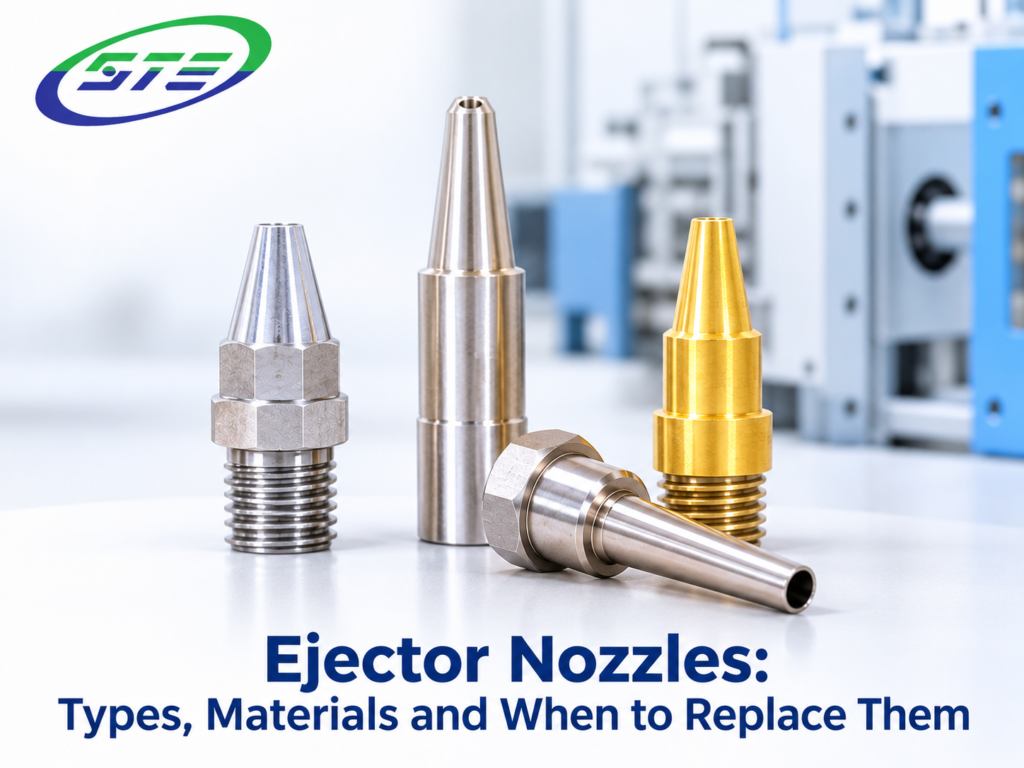
Two ejectors can sit side by side on a skid, share the same flanges and the same body material, and still behave very differently. When we are asked why, the answer is rarely the body. It is the small machined part tucked inside it.
That part is the ejector nozzle, the heart of the whole device. Motive liquid accelerates through it, suction forms at its exit, and the dosing ratio your process depends on is largely determined by its shape. It is also the first thing to wear, which is why a plant that understands its nozzle usually has an ejector that lasts.
What the Nozzle Actually Controls
An ejector has no moving parts, so performance comes from geometry and flow. Pressurised water squeezes through the nozzle, speeds up, and pressure drops. That pressure drop pulls the secondary liquid, whether acid, caustic or brine, into the mixing zone.
Change the bore, profile, or finish of the nozzle even slightly, and you change the suction. Most people don’t realise the nozzle doesn’t fail dramatically. It drifts. The draw slows slightly, the dilution becomes less predictable, and the plant adapts around it until a resin bed or dosing target starts complaining.
Types of Ejector Nozzles
At Sai-Tech, nozzles follow the ratio of the ejector they belong to. There are three families.
1:1 ratio nozzles
These are usually convergent nozzles made as a single part. The design is simple, which is part of its appeal. One component, one flow path, and a unibody ejector suited to duties that call for a one-to-one mix of motive liquid and chemical.
1:5 ratio nozzles
Here the design changes. A 1:5 nozzle set combines a convergent section and a divergent section, manufactured in two parts. That extra stage is what lets the ejector draw a much larger volume of secondary liquid for the same motive flow, and it is the common choice for chemical regeneration in DM plants.
Custom nozzles
Not every process fits a standard ratio. When your process needs a different mixing ratio, flow rate, or dosing target, the nozzle is where the redesign starts. We manufacture custom nozzles to the duty, which is often better than forcing a standard ejector to do a job it wasn’t sized for.
Materials: Match the Nozzle to the Chemical
A nozzle that suits one chemical can be wrecked by another. We make ejector nozzles in several materials, and the choice depends on what flows through it and at what temperature.
- Ebonite. A natural fit for the MSEL range, which is built for hydrochloric acid and caustic dosing in DM plants.
- Polypropylene (PP). Suited to chemicals that attack metal, in applications at moderate temperatures.
- SS316. A sturdy metallic option where stainless steel suits the duty, and the plant prefers a rigid, wear-resistant part.
- Teflon or PTFE. The choice for highly aggressive chemicals and higher temperatures. Our PTFE-lined ejectors are built for fluids like sulphuric acid at 60 degrees Celsius and above.
- Brass or gunmetal. Used in our cast iron ejector for softener plants, handling brine and caustic duty where the body is unlined.
The same logic applies to any industrial ejector nozzle. Choose based on the chemical in contact with it, not the price on the quotation.
When to Replace an Industrial Ejector Nozzle
In our experience, plants tend to replace a nozzle later than they should and an entire ejector earlier than they need to. Because the nozzle is a separate, replaceable component, you rarely need to scrap the body when the nozzle is the worn part.
Here are the signs worth acting on.
The chemical draw is slower than it used to be. If a regeneration step that once took a set time now takes noticeably longer, suction has fallen. Check the nozzle and the suction line first.
The dilution is no longer consistent. Partially regenerated resin or cycle-to-cycle dosing variation often points to a nozzle whose bore has changed.
You can see surface damage. Pitting, erosion at the orifice, or cracking and lifting in a lined or non-metallic nozzle signals replacement, not monitoring.
There are deposits you cannot clear. Scale or solids can partly block the orifice. A careful clean sometimes restores it. If a nozzle stays blocked, or is damaged by cleaning, replace it.
A word of caution here. Never open up a blocked or worn orifice by drilling or reaming it. It may feel like a quick fix, but an enlarged bore changes the jet, and a changed jet changes everything downstream. Replacing it to the original dimensions is the right answer.
For practical planning, inspect the nozzle at planned shutdowns rather than waiting for a symptom, and keep a spare on the shelf for critical dosing lines. A nozzle costs a fraction of the downtime it prevents.
Ordering a Replacement That Actually Fits
A replacement only works if it matches the original and the duty. When you contact us for a spare nozzle, it helps to have the following ready:
- The ejector ratio, 1:1, 1:5 or custom
- The material of construction of the ejector and the nozzle
- The chemical being drawn, and its concentration and temperature
- The motive water pressure and flow where the ejector is installed
- The old nozzle itself, or a clear photograph of it
If you are unsure of any of these, send what you have. A worn nozzle usually tells us a good deal about the duty it was working under.
A Small Part Worth Getting Right
The nozzle is the least visible component of an ejector and the one that determines its performance. Choose the right type for your ratio, the right material for your chemical, and replace it based on evidence rather than guesswork, and the rest of the ejector can run for years without drama.
If you are sizing a new nozzle, replacing a worn one, or trying to work out why a dosing line has gone quiet, the team at Sai-Tech Engineers is happy to help. Tell us about your duty, and we will point you to the right ejector nozzle, built to your ratio and material requirements. You can see the full range at MSEL Ejectors.