
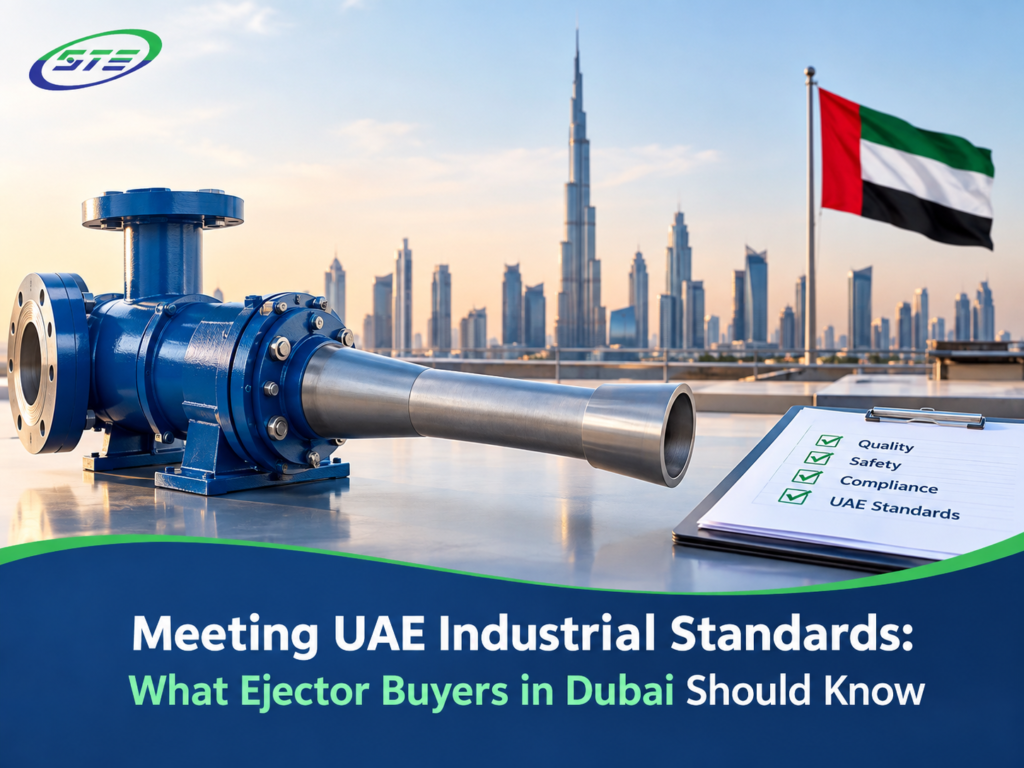
A procurement engineer in Jebel Ali once put it plainly: “The ejector itself was never the problem. Clearing customs with it was.” That single line captures what many buyers discover only after their shipment gets held up: sourcing the right equipment and meeting the UAE’s compliance expectations are two different challenges, and getting one right doesn’t guarantee the other.
If you’re specifying an ejector for a water treatment plant, a chemical processing unit, or a desalination facility in the UAE, understanding UAE industrial equipment standards isn’t a bureaucratic afterthought. It’s part of the engineering decision itself, right alongside material selection and mixing ratio.
Why UAE Industrial Equipment Standards Matter More Than Buyers Expect
Here’s where things get interesting. Most industrial buyers assume that if a piece of equipment performs well and comes from a reputable manufacturer, it will clear import without friction. In practice, the UAE’s regulatory environment, shaped by ESMA (Emirates Authority for Standardisation and Metrology) and Dubai Municipality requirements, layers additional scrutiny on top of pure performance criteria.
What most people don’t realise is that UAE industrial equipment standards aren’t just about the equipment functioning correctly under operating conditions. They also govern documentation, material traceability, conformity marking, and in some cases, third-party testing certificates that need to accompany the shipment before it ever reaches the plant floor. An ejector that performs flawlessly on paper can still sit in a bonded warehouse if the compliance trail behind it is incomplete.
Dubai Import Compliance for Ejectors: What Actually Gets Checked
In our experience working with buyers across the Gulf, Dubai import compliance for ejector equipment tends to focus on a few recurring areas:
Material of Construction (MOC) Documentation
Whether you’re importing an MS Ebonite-lined ejector, an SS316 unit, or a Teflon-lined design for highly corrosive dosing, customs and regulatory bodies increasingly expect clear material certification. This isn’t unique to ejectors, but it catches buyers off guard because domestic suppliers rarely ask for this level of paperwork upfront.
Pressure and Process Rating Declarations
Since an ejector operates on the Venturi principle, using motive fluid pressure to entrain and mix a secondary liquid, the equipment’s rated operating pressure needs to be documented clearly. Dubai import compliance checks often verify that declared specifications match what’s stamped or labelled on the unit itself.
Conformity Marking and Origin Documentation
Depending on the application, whether it is a DM plant, a fertiliser facility, or a sugar processing unit, buyers may need country-of-origin certificates and conformity declarations that align with ESMA’s framework. Skipping this step is one of the most common reasons shipments get delayed at the port rather than at the factory.
Ejector Certification UAE: Separating What’s Optional From What’s Not
This is the part that’s easy to overlook. Not every ejector requires the same level of certification, and treating every import as if it needs the maximum paperwork wastes time, while under-documenting a critical process application creates real risk.
Ejector certification UAE requirements generally scale with the criticality of the application. A softener ejector dosing brine in a low-hazard setting typically faces lighter scrutiny than an ejector used for acid or caustic dosing in resin regeneration, where the consequences of equipment failure are far more serious. If your project falls into a regulated sector, such as water treatment infrastructure tied to a municipal or semi-government contract, expect the certification bar to sit considerably higher.
The practical takeaway: talk to your supplier about certification requirements before the design is finalised, not after the purchase order is signed. A manufacturer with export experience into the UAE will already know which test certificates, material traceability documents, and conformity declarations typically accompany a shipment for your specific application.
Why Manufacturing Origin Affects Compliance Outcomes
At Sai-Tech, having shipped ejectors into the UAE, Saudi Arabia, and across the wider Gulf region for years, we’ve seen how manufacturing discipline upstream directly shapes how smoothly equipment clears compliance downstream. An ejector built with rigorous in-house testing and proper raw material vetting doesn’t just perform better in the field; it also comes with a documentation trail that satisfies UAE industrial equipment standards without last-minute scrambling.
This matters because ejectors, unlike pumps, have no moving parts to fail mechanically, which is precisely why plants across water treatment, fertiliser production, and chemical processing prefer them. But that reliability advantage only translates into a smooth import experience when the manufacturer treats certification and traceability as seriously as they treat nozzle geometry and diffuser design.
Getting Dubai Import Compliance Right From the Start
A few practical habits make a real difference for buyers navigating this process:
Ask your supplier directly which certificates accompany the shipment, rather than assuming standard documentation covers UAE-specific requirements.
Confirm material and pressure ratings are documented in a format that aligns with ESMA expectations, not just generic technical datasheets.
Clarify early whether your specific application (municipal water treatment, for instance) triggers a higher compliance tier than a standard industrial process.
Build in lead time for documentation review, since compliance delays at the port are often more time-consuming to resolve than manufacturing lead times themselves.
Where This Leaves UAE Buyers
Meeting UAE industrial equipment standards isn’t about adding red tape to an already technical purchasing decision. It’s about recognising that in a market like Dubai, equipment quality and equipment compliance move together, and treating them as separate conversations is usually what causes the delays buyers are trying to avoid.
If you’re evaluating an ejector for a project in the UAE and want to understand what certification and documentation your specific application will require, it’s worth having that conversation with your manufacturer before finalising specifications. At Sai-Tech, we work directly with buyers across the Gulf to make sure the ejector that leaves our facility clears compliance as smoothly as it performs on the plant floor.