
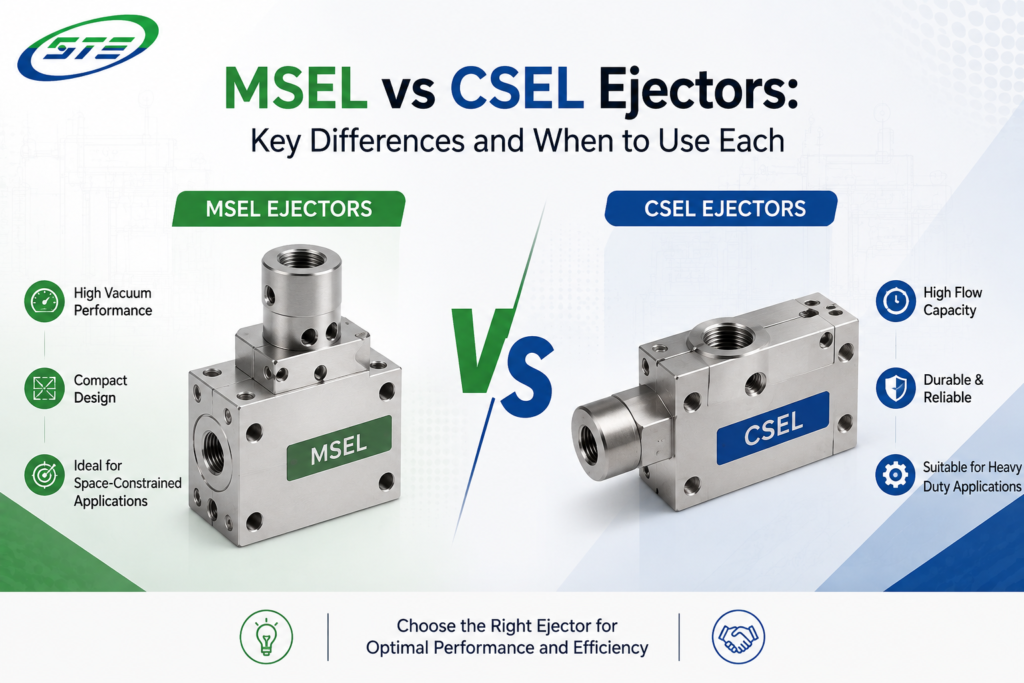
MSEL vs CSEL Ejectors: Key Differences and When to Use Each
A plant engineer once told us he had spent three days chasing a dosing pump fault before someone suggested he simply switch to an ejector. No motor, no seals, no moving parts to wear out. That conversation is where most people’s ejector journey starts. But once they are sold on the idea of a venturi-based ejector, a second question follows almost immediately: MSEL or CSEL, which one actually fits my plant? It sounds like a small detail. It isn’t. Get the body material wrong on a chemical dosing ejector, and you are looking at premature corrosion, unplanned shutdowns, and a replacement order sooner than you budgeted for. At Sai-Tech Engineers, we get asked about MSEL vs CSEL ejector selection almost every week, usually from someone comparing quotes or specs and unsure which one their process actually needs. This piece walks through what separates the two, so you are not guessing. What Makes an Ejector “MSEL” or “CSEL” in the First Place Before comparing the two, it helps to understand what the letters stand for. MSEL is short for Mild Steel Ebonite Lined. CSEL stands for Carbon Steel Ebonite Lined. Both are among the standard types of ejectors that Sai-Tech manufactures for chemical dosing applications, and both work on the same operating principle: a high-pressure motive liquid passes through a nozzle, creates a vacuum, and draws in a secondary liquid at a fixed ratio. No pump, no power supply, no moving internals to maintain. Where they differ is in the outer body construction. The MSEL Ejector uses a mild steel outer body with plate-type flanged end connections, and threaded connections can be made on request for specific installations. The CSEL Ejector uses a carbon steel outer body, also with plate-type flanges as standard, with threaded options available for custom requirements. Both are internally lined with ebonite, which is the layer actually doing the work of resisting the chemical being dosed. MSEL Ejectors: Where They Fit Best The MSEL Ejector is Sai-Tech’s standard product for what we would call typical service conditions. It is built for hydrochloric acid and caustic dosing applications where the corrosion factor is manageable, and the operating temperature stays within 55 degrees Celsius. In our experience, this is the ejector that most water treatment plants, DM plants, and softener systems reach for first, because it covers the majority of standard chemical dosing needs without over-specifying the equipment. If your process runs HCl or caustic at controlled, moderate temperatures, MSEL is usually the practical, cost-effective starting point. Every MSEL Ejector from Sai-Tech comes with a warranty against manufacturing defects, and each unit goes through multiple in-house quality tests before it leaves the factory. That is not a marketing line. It reflects how we have approached manufacturing since 1996, and it is part of why plants across India and overseas keep coming back to us as their ejector manufacturer of choice. CSEL Ejectors: Where They Come In The CSEL Ejector serves the same core purpose, dosing HCl and caustic, but with a carbon steel outer body instead of mild steel. What most people don’t realise is that this is not a case of one material being universally “stronger” than the other. Carbon steel and mild steel behave differently in terms of durability, machinability, and how they hold up under specific plant conditions, which is why Sai-Tech offers CSEL as a distinct option rather than a simple upgrade tier. Like the MSEL, the CSEL Ejector is rated for hydrochloric acid and caustic applications up to 55 degrees Celsius, and it carries the same warranty and quality-testing standards. The decision between the two usually comes down to what your plant’s engineering team specifies for the outer body, based on the installation environment, existing piping standards, or a preference already established at the facility. MSEL or CSEL: Which Is Better for Your Application? Here’s where things get interesting. There is no single answer to which one is objectively better, because the honest answer depends on what your process actually needs. A few questions worth considering before you decide: What chemical are you dosing, and at what temperature? If you are working with HCl or caustic within the 55-degree Celsius range, both MSEL and CSEL are viable. If your process runs hotter or involves something more aggressive like sulphuric acid, that shifts the conversation toward a different material altogether, such as PTFE or Teflon-lined ejectors, which Sai-Tech also manufactures for higher temperature and higher corrosion service. Do you already have a body material standard at your plant? Many facilities standardise on either mild steel or carbon steel across their piping and fittings for procurement and maintenance consistency. If that is the case, matching your ejector to the existing standard usually makes the most operational sense. What does your budget and delivery timeline look like? MSEL is Sai-Tech’s most widely stocked standard configuration, which often makes it the faster and more economical route for straightforward dosing needs. CSEL is equally reliable but may be worth confirming lead times on if your project has a tight schedule. Are you working within a 1:1 or 1:5 ratio setup? Sai-Tech manufactures both MSEL and CSEL Ejectors across 1:1 ratio unibody construction and 1:5 ratio two-part construction, so ratio requirements do not restrict your material choice. This is worth flagging to whoever is finalising your ejector spec. Why the Material Choice Deserves More Attention Than It Gets It is tempting to treat the outer body material as a minor line item on a purchase order. We would push back on that. An ejector’s outer body is what stands between your process fluid and the surrounding plant environment for years of continuous or intermittent service. Getting it wrong does not usually cause an immediate failure. It shows up eighteen months later as unexplained leakage, a support engineer on site, and a production line waiting on a replacement part that should have been correctly specified the first time. This is also why Sai-Tech has stayed focused on rigorous raw material
MSEL vs CSEL Ejectors: Key Differences and When to Use Each Read More »